
For 75% of hotel guests, technology only makes sense if it speeds up service rather than replacing staff. In an era fascinated by artificial intelligence, the hospitality industry therefore faces a key question: where does machine assistance end and genuine hospitality begin? According to Aneta Klepacka-Kołbuk from MCC Mazurkas Conference Centre & Hotel, in a world dominated by codes and algorithms, human attention is becoming the most valuable asset and the only real competitive advantage.
“Technology in hotels is nothing new, although today its development is moving faster than ever before. I remember the beginnings of the Mazurkas hotel 25 years ago – back then, all reservations were entered manually into large ledgers, and the first computer at the reception desk was a real sensation. Today, we simply cannot function without digital tools because they organize the entire logistics and guest service process. But we are also starting to see a clear boundary. Recent years have been a time of major testing: some solutions genuinely helped us, but many others turned out to be expensive gadgets that simply did not work in day-to-day operations,” says Aneta Klepacka-Kołbuk, General Manager of MCC Mazurkas Conference Centre & Hotel.
Technology as Support, Not a Replacement
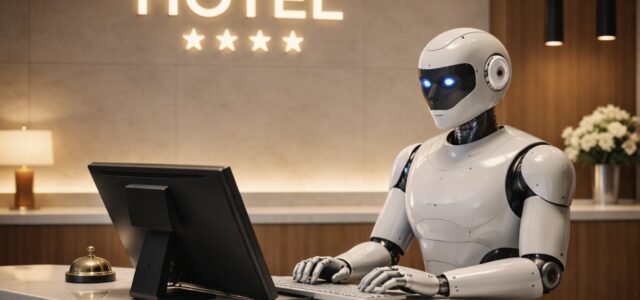
Practice shows that not every advanced solution finds real application in everyday operations. Virtual events, although they gained popularity during the pandemic, did not replace face-to-face meetings. The B2B sector quickly returned to in-person conversations, based on the principle that relationships are built in the hallways, not in front of a screen. Similarly, robot receptionists or experimental tools such as Google Glass proved to be more of a marketing feature than actual operational support. This demonstrates a key principle: in hospitality, technology must provide concrete practical value. The “wow” effect alone is not enough.
“From an operational perspective, advanced digital tools are invaluable today. Reservation systems, sales platforms, and analytics simply allow us to work faster and avoid wasting resources. According to consulting firm Deloitte, this type of AI application can reduce costs by as much as 30%, illustrating the scale of automation’s potential in back-office operations,” says Aneta Klepacka-Kołbuk. “For me, however, this is where the practical applications of technology in our industry end. Genuine quality and human relationships simply cannot be programmed into code,” the expert emphasizes.
The Limits of Technology: Human Connection
In hospitality, there is a clear limit to automation. This is particularly evident in large conference venues and the premium segment, where the scale of operations and customer expectations require a high level of personalization and coordination. During events attended by hundreds of people, technology can quickly become a bottleneck – just imagine a queue forming at a single machine distributing room cards during a coffee break. This shows that not every process can be automated on a large scale without human involvement.
“The global AI market in hospitality is growing at nearly 10% annually, but the majority of this growth is generated by smart hotels and fully automated properties. In Japan, such facilities are very popular. In the premium segment, however, the situation is different. In professional conference services or catering, where every detail matters and quick responses to unexpected situations are essential, people will remain the most important factor,” points out Aneta Klepacka-Kołbuk.
“Technology is worth implementing where it genuinely removes burdens from the team’s shoulders, but never where it would dictate the standard of service. According to data from technology company Oracle, nearly 75% of hotel guests believe technology only makes sense when it speeds up service rather than replacing staff. This clearly shows that a hotel is not just a service – it is, above all, an experience lived by the guest and created through human interaction. A smile, a conversation, flexibility, or the ability to respond ‘here and now’ to unusual needs determine whether a stay will be remembered as successful. And even the most advanced technology cannot provide that,” the expert notes.
Will AI Become a Competitive Advantage?
Available data shows that around 98% of hotels already use back-office solutions based on automation and artificial intelligence to some extent. Digital tools are no longer a competitive advantage but are becoming an industry standard. This means that competitive advantage increasingly stems not from the technology itself, but from how it is used in guest relations.
“Recently, I read that as many as 7 out of 10 hotel owners declare they plan to continue implementing artificial intelligence and automation, but they are not entirely sure which direction to take. For us, this is a clear signal: in the coming years, the biggest challenge will not be purchasing more software, but competing for skilled people. The key is to intelligently relieve the team from time-consuming spreadsheets and procedures so they can focus on the guest. The most valuable asset of a hotel is the human being – their attentiveness, empathy, and intuition. In the premium segment, people pay for relationships, and those cannot be programmed,” concludes Aneta Klepacka-Kołbuk.


