
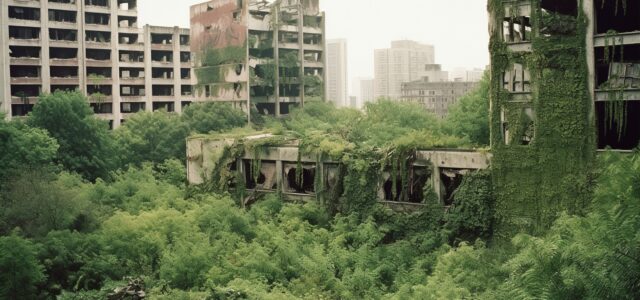
Ghost cities and bursting metropolises – this is Poland’s future
Investments 22 January 2026 Patrycja
The recent report from the Statistics Poland (GUS) shows that by 2060, the population will dwindle to only 28.4 million. This is a drop of 24.3% compared to 2024. What does this mean for cities, towns, and entire regions? Does a population decline mean a housing market collapse? Or is it quite the opposite? What awaits us in the future?
– Demographics are a bit like the emperor in the fairy tale who walked around naked while everyone pretended not to see the problem. This is exactly the situation. It has already happened. Why? Because demographic processes have such a long duration and development time that we missed the moment when something could still have been done to stop the population decline in Poland – says Maciej Gołębiewski, an expert in real estate investment and creator of dobregonajmu.pl.
Demographics Down, Real Estate Up?
Demographics do not end with a simple head count. It is only one of the layers shaping today’s real estate market. The paradox lies in the fact that although the number of Poles is physically decreasing, the number of households is increasing. GUS forecasts that by 2050, the percentage of single-person households will rise from today’s 25% to over 33%. This happens because one phenomenon drives the other: the smaller households become, the more of them are created. In the 1960s, an average of 3.5 people lived under one roof; today it is slightly over 3, and soon it will be around 2.5.
– An increase in the number of households despite a population decline? It’s not a paradox, but the effect of changes that have been happening quietly for years. Today, one family increasingly turns into two separate homes because divorces, separations, or simply living “on one’s own terms” have become commonplace. Furthermore, the model that was obvious until recently—a house full of three generations—is slowly disappearing. In the past, grandparents, parents, and children lived together, and when building a house, one immediately thought about where the next generation would get their floor. That is history. Today, everyone lives more separately, more their own way, and wants more than just their piece of the floor. All of this means that despite fewer people, we need more apartments—and much faster than demographics alone would suggest – emphasizes Maciej Gołębiewski.
Houses for a Zloty
At the beginning of the 21st century, the depopulation of entire regions in eastern Germany was a phenomenon so tangible it was hard to miss. Residents of cities like Frankfurt (Oder) simply packed up and moved west, where there were jobs, money, and prospects. Vacancies grew like mushrooms after rain, and some apartment blocks were dismantled because no one believed they would ever be filled again. We recently saw a similar image in Italy, where houses in many small towns were listed for one euro—not to make a profit, but so that anyone would take care of them and save the local community from total disappearance.
– The depopulation of villages and the growth of cities is nothing new. Throughout the centuries, people moved from less developed areas to where they had better chances for prosperity. This was happening hundreds of years ago, but now it is taking on a very tangible dimension – says Maciej Gołębiewski. – I was in Białowieża recently. A wonderful place, but as you drive there—already over a hundred kilometers from Warsaw—it turns out that many towns are empty. This is exactly that mechanism. It is in those regions that the depopulation of the countryside is most visible – he adds.
– Over time, more places will appear where there are simply more apartments than people willing to live in them. Then prices will start to fall. Not because the market will collapse, but simply because there will be no one to take over these houses and apartments. And that is the heart of the problem. “Provincial Poland” faces one of the greatest demographic challenges in its history, and its future depends almost exclusively on whether it can “plug into” larger centers. If a town is not well-connected and does not serve as a convenient bedroom community for a large agglomeration, it is hard to expect the local housing market to survive, let alone develop. The mere presence of one large company employing several hundred or several thousand people guarantees nothing—one board decision can turn the entire local economy upside down. Wałbrzych or Detroit are the best proof of how quickly the collapse of one industry can pull an entire city down with it – notes the expert.
Safe Islands?
According to long-term GUS forecasts, by 2050, more than 90% of counties (powiats) will lose part of their residents. Who will benefit? Large cities. They are already the main poles of growth—this is where jobs, universities, and high-level services are concentrated. It is no wonder that young people from the provinces are less likely to stay in their hometowns and more likely to leave for larger centers. They migrate in search of education, professional development, and better life prospects. Which cities are they moving to?
– Analysis of the future population broken down by counties paints a clear picture: we will observe real population growth exclusively in the Warsaw agglomeration and Kraków and its surroundings. The resident growth in these metropolises will be small, but significant compared to the rest of the country. In sharp contrast to these centers will be Łódź, which has lost over 25 percent of its inhabitants from 1989 to today and, according to GUS forecasts, is heading toward a decline of around 40 percent. This dramatic trajectory well illustrates the scale of transformation awaiting many large and medium-sized cities in Poland in the coming decades – says the expert.
Growing “Bagels”
More and more residents of large cities are moving to neighboring municipalities. This phenomenon is confirmed by data from the Metropolie.pl portal, which shows that while the population growth within administrative city limits is slower, entire metropolitan areas are developing faster. Between the end of 2019 and 2024, the population growth in Warsaw was 4%, while in suburban municipalities, it was 10%. Escaping the city is associated with building houses in quieter but still well-connected locations. This step is taken not only by those who can afford to invest in a house outside the city but also by those who want to improve their standard of living, yet property prices within city limits exceed their capabilities. This second group usually settles for a terraced or semi-detached house.
– Having your own four corners with a garden is a dream for many Poles. Otodom research shows that over 70% of us would most like to live in a single-family house—preferably one that stands a bit further from the city bustle. No wonder cheaper land in suburban zones acts like a magnet – emphasizes Maciej Gołębiewski. – Suburbanization is not just a pursuit of a dream. It is also a hard reaction to the weaknesses of the Polish housing market. We are below the EU average in terms of the number of apartments per 1,000 inhabitants, and as many as 34% of units are overcrowded. In addition, the average area per person is only 31 m²—while in the West, the standard is 40–45 m². It is no wonder that Poles are looking for more space and less crowding. It is this need that naturally pushes people to the outskirts of cities and drives the rapid growth of the “bagels” (suburban rings) – adds the expert.
The Future?
Everything indicates that in the coming decades, Poland will be a country increasingly divided demographically. At the same time, the largest agglomerations, both cities and their suburban “bagels,” will grow and continue to attract people, jobs, and capital. The future of the real estate market will also be determined by the new housing needs of increasingly smaller households. This will push us toward small, compact apartments—just right in terms of size and price. Media reports show that the average size of apartments purchased in the largest cities remains at a level of 50-55 m².
– If the forecasts come true, in three decades, Poland will be a country of two parallel realities. On one side, we will see metropolises that still attract people, work, and capital. On the other—counties slowly fading away, as if someone were turning off the lights one by one. Added to this is growing mobility, increasingly smaller families, and rising financial pressure. All of this pushes us toward compact apartments in cities and living on the outskirts of agglomerations. This balance of power will create a completely new social reality, different from the one we are used to. And here the most important question arises: can we find our way in a Poland that is already starting to look different from the one we know? – wonders Maciej Gołębiewski.


